


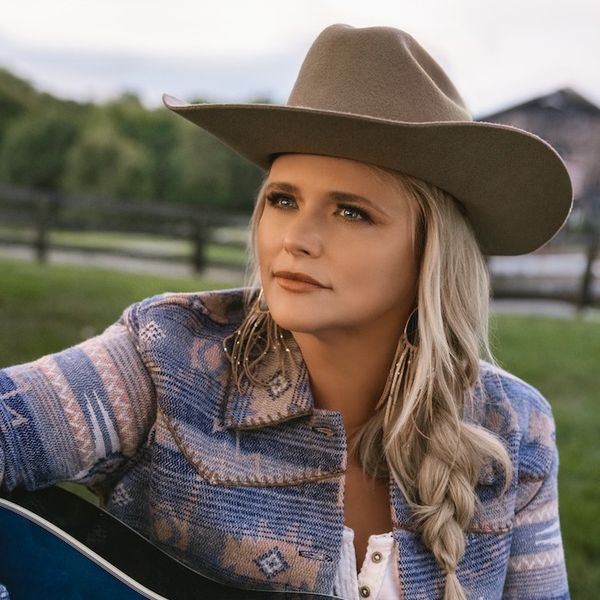
Miranda Lambert Recalls Emotional Fan Encounter About ‘Gunpowder & Lead’: “Then We Cried Together”
By Laura Halse


Link copied

Miranda Lambert has been singing ‘Gunpowder & Lead’ for almost 20 years and whilst it's become one of the biggest moments in her live shows, it's the stories she's heard from women offstage that have arguably had the most impact on her. During a recent interview, Lambert recalled one encounter with a fan who didn't want a photograph. Instead, she wanted to tell the country star how her song had changed her life.
Speaking to songwriter Ross Golan on the And The Writer Is... podcast, released on October 27th, Lambert revisited the story of a woman who approached her during a meet and greet, explaining that she'd been in an abusive relationship and that hearing 'Gunpowder & Lead' had given her the courage to take action.
"I did shoot him, and I got off," Lambert recalled the woman telling her.
Lambert was stunned by the admission, explaining that the woman was completely serious about what she'd told her. "Then we cried together," she shared. Lambert admitted that she needed a moment to collect herself before continuing with the meet-and-greet. It was quite a conversation to have with someone who had simply come to see her perform, but it also showed just how much the song had meant to the woman standing in front of her. And to understand why 'Gunpowder & Lead' means so much to Lambert, you have to go back to her childhood in Texas.
Lambert’s parents worked as private investigators, often dealing with families affected by domestic violence. But their involvement didn't always end when a case was over. Between the ages of 14 and 18, Lambert sometimes shared her family home with women and children who were escaping abusive relationships. Lambert was witnessing firsthand what domestic abuse could do to a family, something that would later translate into her songwriting.
‘Gunpowder & Lead’, which featured on Lambert’s 2007 album Crazy Ex-Girlfriend, was co-written with Heather Little, who is a survivor of domestic abuse. The song tells the story of a woman waiting for her abusive husband to return home after being released from jail, preparing to confront him with a shotgun.
The song was a risk for country radio at that time, especially for a young female artist still establishing herself in Nashville. Speaking to Reba McEntire and Ella Langley during an interview earlier this year, Lambert recalled how releasing the song had been one of the biggest risks of her career. She explained that whilst singing about shooting an abusive husband wasn't necessarily going to be popular on country radio, she'd grown up seeing the realities behind the song and felt it was important to tell that story. "It needed to be said," she explained. That risk paid off and the song went on to become a major milestone in her career. But the stories behind it have always meant far more than the chart positions.
In a 2013 interview with Redbook, Lambert recalled a woman turning up unexpectedly at her home, crying and asking for help after hearing 'Gunpowder & Lead'. Lambert contacted her mum and together they helped arrange somewhere safe for the woman to stay. And during a 2014 interview with SPIN, Lambert explained that women regularly approached her at meet and greets to share their own experiences of domestic violence, sometimes telling her that the song had saved their lives.
Lambert has previously spoken publicly about the woman who told her she'd shot her abusive husband, including during Country Radio Seminar in 2020. But hearing her revisit the encounter six years later and the emotion they shared afterwards shows just how much the conversation has stayed with her.
But Lambert certainly wasn't the first country artist to tackle domestic violence through her music.
Back in 1994, Martina McBride released 'Independence Day', telling the story of an abusive relationship through the eyes of a child. McBride has since spoken about women approaching her to share their own experiences including one who credited the song with helping her leave an abusive relationship after 14 years.
Six years later in 2000, The Chicks faced controversy with 'Goodbye Earl', a song about two women taking revenge on an abusive husband. Some country radio stations refused to play it whilst others used the opportunity to share domestic violence helpline numbers.
Nearly 20 years after 'Gunpowder & Lead' was released, women are still approaching Lambert with their own experiences. It's something Lambert has continued to speak about throughout her career, particularly given the experiences that inspired her to write it in the first place.
These aren't always easy stories to tell, or to listen to, but that doesn't mean they shouldn't be told. And whilst country music has never shied away from difficult subjects, it's important that we continue to shine a light on domestic violence rather than cast a shadow over it.
If you or someone you know is affected by domestic abuse, support is available: Refuge’s National Domestic Abuse Helpline (UK) is 0808 2000 247 for women and Respect Men’s Advice Line (UK) is 0808 8010327. The National Domestic Violence Hotline (USA) is 800-799-7233.

Comments
Anyone can read the comments. You need a free account to post one.
Loading comments…
Keep it civil. Read our community guidelines.