


Zach Bryan Explains How His Mother’s Death Shaped His New EP Title: “No One Was Really There”
By Maxim Mower


Link copied

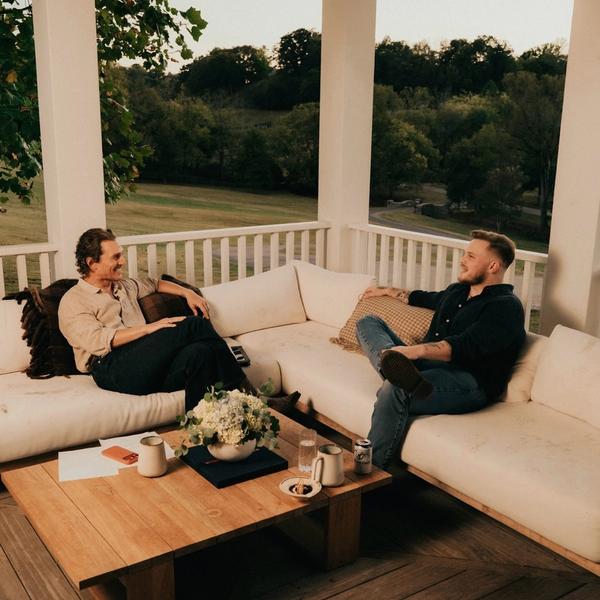
During Zach Bryan's sweeping, in-depth conversation with Matthew McConaughey about his new EP, Young Manhood & Other Donatable Organs, the ‘Something in the Orange’ hitmaker reveals how the title links to the loss of his mother.
The country-folk titan's mother, Annette DeAnn Bryan, died in 2016 at the age of 49, with Bryan having penned a number of tracks in her honour, including ‘Sweet DeAnn’.
While chatting to McConaughey, Bryan discusses how lonely it felt being in the hospital while the doctors were trying to help his mother recover, after she'd passed out inexplicably.
Bryan recalls, “It was like a coming-of-age title for me. I said it one day because when I was 19, I was about to go on this deployment. I was about to go to the Middle East, and my sister called me, and this was, I mean, the beginning of my young manhood. I was like 19, you know? My sister calls me, and she says, ‘Hey, mom passed out. She's in the hospital’, and so I drove four hours from Nebraska, and I ended up in this waiting room, in this hospital, and I ended up staying there for two weeks because she had fallen into a coma. And it was supposed to just be like she fell over, she fainted, she's back up. Oh, mom's back”.
He goes on, “But it turned into, like, her brain was dead. So for two weeks I waited there with my mother in her hospital room, and there was still hope. You know, there was still hope for her. People thought she was going to come out of it and things like that”.
Bryan reflects on how jarring the cold, soulless hospital room felt, “Two weeks go by, and I remember laying there in a cot in a waiting room in Tulsa, Oklahoma. And no one was there. Everyone had left, and it was just me, and it was this white, synthetic-bulby room. And this doctor runs through it and yells, ‘Code blue, code blue’. I didn't know what that meant. I thought, I mean, they should have had a better word like ‘Code Death’ or ‘She's dying’. But it was ‘Code Blue’, and I didn't know what it meant. And then 10 minutes later, this doctor comes out and he's like, ‘I'm sorry to inform you that we're gonna have to, like, move on from thinking she's gonna make it out of this. You guys have to make a decision’”.
He reveals that, in that heartbreaking moment where, just moments ago, he thought his mother was going to wake up, someone came and asked if he was happy for his mother's organs to be donated, “I was the only one there, and I had to make the decision. My sister was too emotional. My father wasn't there. Like, no one was really there, and while I was holding her hand as she was taking her last breaths, this guy who couldn't have been 30 years old walks in and he goes, ‘Hey, can you sign these papers?’ I didn't know what they were. I'm like, ‘What are these?’”
Bryan shares that this stuck in his mind for the next decade or so, “He's like...‘Can she donate her organs?’ You know, and my whole, like 20-to-30 years old, I spent just trying to reconcile that. Even when you're at your lowest moment, even when you're dying, people are gonna come and they're gonna ask, and they're gonna need. And I've tried my best. I've given my heart and my soul and my lungs”.
He continues, “I just had to reconcile that through my entire 20’s. Like, man, they're gonna come and they're gonna ask, and they're not going to stop until you're literally in the ground, you know? And I finally one day woke up and was like, ‘That's a good title, because I feel like my entire 20’s I've spent just giving all this s*** to other people, you know? And I came to grips with, they're never gonna stop asking, and I'm not complaining. I'm blessed. I'm blessed. I'm a lucky man. I get to live here. I get to be here, and I get to sing music for a living. But that came from a lot of f***ing donation of my heart, and donation of my lungs, and donation of my hands and my sanity at times...that's why that title means so much to me”.
Bryan references the Young Manhood & Other Donatable Organs memoir that accompanies the EP, “It's why I titled the book that, because I I looked at that title and I saw that f***ing guy looking at me, and I was like, damn, that guy's a metaphor for everything, for every person you're acting for, for every person I'm singing for. They're gonna come and they're gonna ask...Maybe it's not a f***ing metaphor for anyone else, but it meant a lot to me to call it that, and it meant a lot to me for at this point in my life, as I've come to grips with whatever that felt like”.
Elsewhere during the conversation, Bryan touches on how his mother's death felt like a cruel twist of fate, because it happened after she'd managed to get sober after years of alcoholism, “It was really disgusting because she had sobered up, finally, after all these years, and that's when God came for her...It really always haunted me a little bit. It was interesting because after all this time, all these sins she had committed, she finally was on the straight and narrow, completely sober”.
Bryan speaks for the first time about how, despite underlining his love for his mother and his ultimate forgiveness, there was a period of time where she became “an evil person” due to her alcohol abuse. He reflects, “I don't think people know this because I really respect my mother, and I think she's a kind woman. And I named an album after her, and I talk about her with a lot of grandiose and love in these songs. When in reality, for a few years, she was like an evil person”.
He adds, “I was severely abused, you know, beaten, broken noses, broken arms, broken everything, and no one knows any of this. My sisters never told these stories. I've never told these stories, and I thought in our adulthood it was about time, you know?”
But he emphasises that he has forgiven his late mother for this, and underlines he learned that it was not the real her when she was drinking, rather, it was simply her addiction.
It introduces an extra layer of emotional weight to Bryan's meditations on his own sobriety, with the ‘Dawns’ crooner confessing that he felt himself falling into a spiral. Now that he's not drinking, he reflects, he's in a happier space than he's ever been.
This context adds a fascinating new dimension to Bryan's stellar EP, Young Manhood & Other Donatable Organs, with the fact that the title originates from the isolation of that hospital room accentuating the theme of reminiscing that permeates the project.
But as McConaughey points out during their discussion, Bryan is never overly sentimental, nostalgic or wallowing. Rather, as he muses on ‘Backwards’, he is simply looking back at his past, acknowledges his mistakes head-on and learning from them with a sense of detachment, as he determines to keep moving forwards.
Despite its relative brevity, Young Manhood & Other Donatable Organs is a tremendously powerful collection of songs, and one of Bryan's most cohesive bodies of work to date, with each track illuminating the overarching narrative of killing your old self - a concept powerfully captured by the EP artwork - and finding redemption.


Comments
Anyone can read the comments. You need a free account to post one.
Loading comments…
Keep it civil. Read our community guidelines.